The short version:
- AI can now connect directly to your bank's systems, which changes what data infrastructure is actually for.
- Your core provider is about to sell you expensive AI tools that lock you in deeper.
- There are two ways this plays out over the next five years, and the bank prepared for the worse one wins either way.
- The most important move a community bank can make this year is not picking an AI tool. It is taking real control of its data foundation.
I have been having the same conversation with community bankers for about six months now. It starts somewhere familiar — talk of AI, of efficiency, of what is possible — and ends somewhere I am finding harder and harder to watch.
It ends with a banker telling me their core provider is about to pitch them on an AI product. And that they will probably buy it.
I want to put something on the record about this, because I think we are sitting on top of a decision point that most of the industry is sleepwalking through. The choices community banks make in the next twelve months about how they handle data and AI will shape what their business looks like for the next ten years. And from where I sit, most banks are about to make those decisions based on a fundamental misunderstanding of what they are actually being sold.
So let me try to be useful. I am going to tell you what I actually mean when I say "AI." I am going to tell you what your core is about to do with it. And I am going to be honest about the two very different ways this could play out — because I think the bank that prepares for both versions is the one that comes out of this decade in the strongest position.
What we are actually talking about when we say AI
When I say "AI," I do not mean robots. I do not mean whatever you saw in a movie. I do not mean the chatbot on your bank's website that helps customers reset their password.
I mean a specific kind of technology — a large language model — that has been trained on enormous amounts of text and data, and has gotten remarkably good at reading, writing, reasoning, and answering questions. The names you have heard are Claude, ChatGPT, and Gemini. There are others. They are improving rapidly.
Until recently, these models had two limitations worth understanding.
The first was that they could only answer from what they had been trained on. Their knowledge had a cutoff date. They could not tell you anything about the actual world today. That problem got solved a while ago — modern AI tools can search the web, pull current information, cite their sources.
The second limitation is the one that matters for banks, and it is the one that just got solved. Until very recently, these models could not see your data. They could read everything ever published on the internet, but they could not look at your loan portfolio, your transaction history, your customer records. They were brilliant strangers. Useful for general questions, useless for running your bank.
That changed in the last eighteen months. AI can now connect directly to your accounting system and pull a report. It can read your transaction data and flag anomalies. It can sit on top of your operations and tell you, in real time, what is actually happening inside your bank.
The piece of plumbing that makes this work is called MCP — Model Context Protocol, originally developed by Anthropic and now being adopted across the AI industry. You do not need to know how it works. You need to know what it means: AI no longer needs a custom integration to talk to your systems. It can connect to modern software more or less directly.
Three weeks ago I told our engineering team to stop building a data pipeline they had been working on for weeks. I said wait for the MCP to drop. It dropped. The work that would have taken months happened in an afternoon.
That is the shift. The cost of making AI work with your data is collapsing. Which raises a question almost nobody in our industry is asking out loud yet: if AI can connect directly to your systems, what is the data warehouse actually for?
What this should mean for community banks
If you take that question seriously, the traditional architecture starts to look very different.
Today, the workflow is roughly: extract data from the core, pipe it into a warehouse, model it, build reports on top, wait for someone on your team to interpret the report, then make a decision. That entire chain takes days. Sometimes weeks. By the time a community bank president gets the answer to a real operational question, the question has often gone stale.
In the version of the future the technology is pointing at, that chain compresses to seconds. The president of a $400 million bank asks a real question about their loan portfolio and gets a real answer in fifteen seconds. The warehouse, as we have known it, stops being the center of the universe. AI becomes the layer banks ask their questions to, and that AI pulls from wherever the data lives.
That should be very good news for community banks. Less infrastructure. Lower cost. More accessible. The kind of operational visibility that used to require a full data team becomes something a single sharp person can run. (We wrote a longer piece on ten low-risk ways community and regional banks are actually using AI today if you want a closer look at where this lands in practice.)
But that is not the world your core provider is selling you.
What your core is selling you is an AI tool, bundled into the contract you are already locked into, priced as a premium add-on, that talks to their data — not yours.
This is the move every banker in America needs to see coming.
The play the cores are running
The three dominant core providers — FIS, Fiserv, Jack Henry — have spent decades perfecting one of the most lucrative business models in financial services. Lock the customer into a five-year contract. Make migration so expensive nobody actually does it. Then charge for every incremental piece of value, year after year, comfortable in the knowledge that the customer has nowhere to go.
That model is now meeting AI.
I am not guessing how this plays out. We are already watching it happen. One bank we work with was told that adding a few extra columns to their core data extract — columns they needed, from their own data — would cost an additional $2,500 a month. The data was not expensive to produce. The core could charge it. The bank, lacking leverage, paid.
Now extend that logic forward. Your core announces an AI-powered AML platform. It is $10,000 a month. You compare it to the loaded cost of hiring an FTE to do the same work, and the math gets just close enough to make you sign. So you sign. Then they announce an AI-powered loan analytics tool. Another $8,000 a month. Then customer service. Then reporting. Three years from now you are paying your core $200,000 a year for AI services that — if you owned your data — you could be running yourself for a fraction of that.
This is the play. Cores have always charged banks for what banks could do themselves if they controlled their own data. AI is the next, and most expensive, version of that game. We have written before about how data silos quietly cost banks millions of dollars a year — this is the next chapter of the same story.
Two versions of where this ends
Here is where I have to be honest with you about something I have been wrestling with for months.
There are two very different ways this could play out, and I genuinely do not know which one wins.
In the first version, the technology keeps doing what technology does. The cost of connecting AI to your systems falls. AI vendors compete with each other and prices come down. Banks that own their data foundation can run powerful AI on top of it for a fraction of what cores want to charge today. Five years from now, the cores have been forced to climb down because banks finally have an alternative that works. The community banking industry comes out of this decade stronger, more independent, and more capable than it went in.
This is the version I want to be true. I think there is a real case for it.
In the second version, the technology gets cheaper and more powerful exactly like I just described — but it does not save anyone, because the data sources AI needs to connect to start charging like cores do.
Think about what your bank actually runs on. Your core is one system. But around it sit your loan origination platform, your customer relationship system, your card processor, your digital banking provider, your fraud monitoring tool, your accounting software. Six, eight, ten vendors. Today most of them charge reasonable fees for data access because nobody is really using it at scale. The minute AI makes that data valuable at scale, every one of those vendors realizes what they are sitting on. And they start pricing it accordingly.
In this version of the future, you do not get squeezed by one expensive core. You get squeezed by ten smaller vendors who each figured out the same trick. The architecture works. The AI is brilliant. But the bank is paying a fortune in access fees just to let it do its job.
I do not know which version is right. I suspect the honest answer is some of both — that some data access commoditizes and some does not, and the line between them is going to be drawn in the next few years by the choices banks make right now.
What I have stopped doing is betting on only one of them.
What AI cannot do for a community bank, in either version
There is one more thing worth saying clearly, because it is true regardless of how the rest of this plays out.
AI is not a substitute for judgment. It is not going to replace your senior compliance analyst. It is not going to read between the lines of an examiner's letter. It is not going to develop the kind of instinct that takes twenty years of regulatory relationships to build.
There is a saying I have come to believe about fraud analysts: they are born, not made. Good ones have a gut sense that the data does not fully explain — a pattern recognition that comes from years of looking at things that almost added up but did not. AI does not have that. AI has context, which is a different thing entirely. It can read every regulation ever written and still not know what your examiner actually means.
What AI is genuinely excellent at is the work underneath the judgment. Drafting SAR narratives from transaction data. Writing AML rule logic. Flagging anomalies for a human to evaluate. Pulling quarterly reports together. This is the volume work that currently consumes most of your team's time, and it is the work that is going to get a lot cheaper to do.
But here is the thing your core is counting on. They want to charge you premium prices for exactly the work AI is best at — the volume work, the mechanical work, the stuff a bank with control of its own data could be running internally. The human judgment work, the part that actually matters, stays with your people no matter what. The bank that figures this out first stops paying its core a fortune to do the easy half.
The invoice nobody has seen yet
One more thing, because we are heading into a year of price shocks on this.
Most community banks experimenting with AI today are doing it on consumer or small-business plans. Twenty dollars a month per user. Easy to budget. Easy to justify.
That is not what AI costs when you run it at scale through a direct API. It is not what it costs when AI agents are running continuously against your transaction data, generating reports for every department every morning, sitting inside your customer service flow.
The first time a community bank opens an invoice and sees a five-figure monthly AI charge, there is going to be a moment of reckoning. In the first version of the future, that is a transitional cost — prices come down, the market matures, the math gets better. In the second version, that invoice is the new normal, and it goes up from there.
I do not know which version of that bill banks are going to be paying. I do know the bank prepared for the worse one has options. The bank prepared only for the better one does not.
What I would do if I ran your bank
The most important thing a community bank can do this year is not pick an AI tool. It is to take real control of its data foundation. Get your transaction data into a place you own. Build the pipes to make that data usable. Do this whether or not you ever turn AI loose on top of it, because the bank that owns its data is the bank that has options in five years. The bank that does not is the bank still paying its core a quarter million dollars a year to ask basic questions about its own operations.
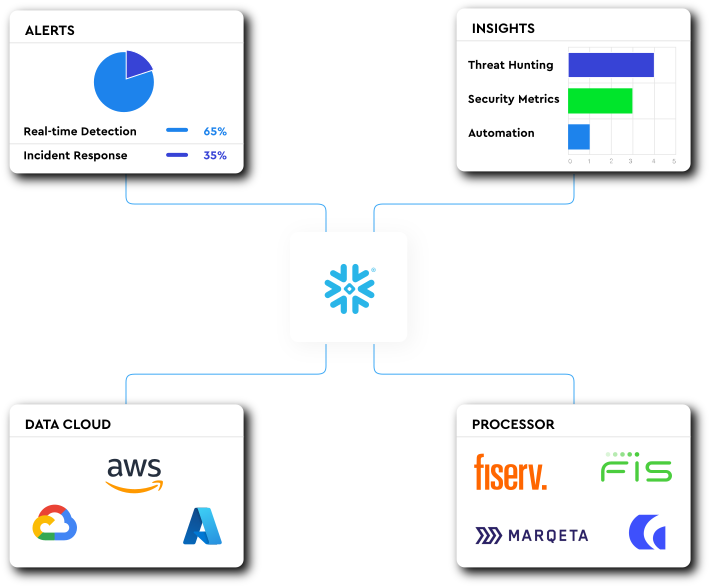
This is the work we do every day with banks and credit unions at iDENTIFY. We help banks get their data out of legacy systems and into Snowflake's AI Data Cloud, where it can actually be used. We help them get AI-ready — not by selling them an AI tool, but by building the foundation that makes any AI tool actually work.
If you do that work — if you take your data seriously — AI becomes useful immediately. Not because it is magic. Because the bottleneck was never the AI. The bottleneck has always been the data. And your core has built a very good business out of keeping it that way.
In the version of the future where the technology gets cheap, owning your data lets you benefit from every fast, capable tool that gets built on top of it. In the version where vendors copy the core playbook, owning your data is the only thing standing between you and getting squeezed by a dozen vendors instead of one. Either way, the answer is the same. Control the foundation. The rest sorts itself out.
Your core is going to call you with an AI offer. The product will work, technically. But what they are selling you is access to your own future, on their terms, at their price, for as long as you let them.
There is another version of that future where the bank owns the foundation, and the AI works for the bank. That version is harder. It takes a year of real work. It requires choosing data engineering over a vendor relationship.
But it is the one worth fighting for. And the banks that fight for it now are going to look very, very smart in 2030.
Frequently asked questions
What is MCP, and why does it matter for community banks?
MCP, or Model Context Protocol, is the technology that lets AI tools connect directly to a bank's existing systems without requiring custom integrations for each one. For community banks, it matters because it dramatically lowers the cost of making AI useful with their own data — but only if the bank actually controls that data in the first place.
Should a community bank buy AI tools from its core provider?
In most cases, no — at least not without first taking control of its own data foundation. AI tools sold by core providers are typically priced as premium add-ons, talk to the core's data rather than the bank's, and deepen the bank's dependency on a vendor that already has significant pricing power. A bank that owns its data can run comparable AI capabilities internally for a fraction of the cost.
What can AI actually do for a community bank today?
AI is most useful for the volume work that currently consumes a team's time: drafting SAR narratives, writing AML rule logic, flagging transaction anomalies, generating reports, and answering operational questions in real time. It is not a substitute for human judgment in compliance, lending, or fraud — those decisions still require experienced people. AI handles the mechanical work underneath the judgment.
What is the first step a community bank should take with AI?
The first step is not picking an AI tool. It is taking control of the bank's data — getting it out of legacy systems, consolidated into a platform the bank owns, and structured in a way that makes it usable. The bank that does this work first is the bank that has real options when AI tools mature. The bank that skips it ends up paying vendors for access to its own information.
Lee Easton is President of iDENTIFY, a Snowflake-native data engineering firm that helps community banks and credit unions own their data future. To talk about getting your bank's data foundation ready for what comes next, reach out to our team.