Banking Trends 2026: What Community and Sponsor Banks Need to Get Right
As we look ahead to banking trends in 2026, one thing is clear: optimism is back, and so is pressure.
Margins are stabilizing, loan activity is improving, and according to Cornerstone Advisors’ 2026 Trend Report, more than 8 in 10 executives are optimistic about the coming year. That optimism carries weight, particularly after a stretch of regulatory pressure and operational recalibration. But beneath that optimism sit familiar concerns: deposit growth, fraud, efficiency, and compliance.
At recent industry conferences including Acquire or Be Acquired, Fintech Xchange, and the Digital Banking & Innovation Summit hosted by Bankwell, the conversations were less about what’s new, and more about moving forward with this new landscape.
Community and sponsor banks are over flashy. They’re asking, “What’s durable?”
And we will beat on this drum till the pigs fly, the banks that win in 2026 won’t be the fastest movers. They’ll be the most structurally prepared.
Here are the four banking industry trends shaping 2026, and what strong banks are doing about them.
1. AI in Community Banking Is Moving From Experiment to Infrastructure
Artificial intelligence has moved from experimentation into active deployment across community banking. Cornerstone’s 2026 Trend Report shows that generative AI adoption has nearly tripled year over year, with roughly one in three banks now piloting or deploying AI tools in production environments. The conversation has shifted accordingly. Instead of asking whether AI belongs in banking, leaders are evaluating how to integrate it responsibly into real workflows.
What stands out most clearly is the operating model that is emerging.
Experienced bank leaders are pairing AI acceleration with human oversight. Tools like Claude Code can handle the heavy lifting in data engineering — generating SQL, drafting transformation logic, and translating legacy batch workflows into cloud-native pipelines. For teams without deep engineering benches, that acceleration can mean 80–95% of the mechanical build work moves faster and with fewer bottlenecks.
What strong banks are doing successfully is pairing that acceleration with oversight. One experienced data engineer or technical lead sits at the top, reviewing architecture decisions, validating business logic, and ensuring regulatory alignment before anything moves to production. The AI speeds up execution, and the human preserves control.
AI can summarize policy.
AI can detect patterns.
AI can accelerate reporting.
What it cannot do, at least not safely, is replace risk judgment.
Large language models hallucinate. They infer. They generalize. In banking, that margin of error can turn into regulatory exposure quickly. AI functions best when it sits on top of governed, unified data. In many ways, it resembles automation inside a modern distribution center. When inventory is clearly labeled, organized, and consistently cataloged, automation increases both speed and accuracy. When organization is inconsistent, automation increases activity without increasing clarity.
The key trend in AI for community banks in 2026 is this: Smart banks are integrated Ai while keeping humans as the gatekeeper
If your data is siloed, inconsistent, and batch-based, AI magnifies fragility.
If your data is unified, governed, and validated, AI multiplies capacity.
The banks that are succeeding with AI in 2026 are:
- Keeping humans in validation loops
- Defining model governance clearly
- Centralizing data before layering automation
2. Stablecoins in 2026: Define the Use Case First
The stablecoin conversation has matured. The question isn’t whether it’s happening; the real question is where it actually creates value.
At recent conferences, you could feel two camps forming in the room. One group sees stablecoins as foundational infrastructure, a natural evolution in how money moves, settles, and becomes programmable. The other group views them through a more measured lens, asking what real customer problem they solve that existing rails do not.
Cornerstone’s 2026 research shows that 71% of banks have discussed stablecoins at the board or executive level, yet deployment remains limited. That gap signals discipline. Banks are studying use cases carefully before committing capital or operational energy.
The clearest use case today is cross-border money movement. Correspondent banking remains slow, layered, and expensive in certain corridors. Stablecoins can compress settlement time, reduce intermediary fees, and improve access to dollar liquidity in jurisdictions where traditional rails introduce friction.
Domestically, the value proposition shifts. Real-time speed is already available through RTP and FedNow. The more compelling advantage becomes programmability, the ability to embed logic into the movement of money itself.
Programmable use cases include:
- Conditional treasury flows
- Automated merchant payouts
- Settlement tied to tokenized securities
- Embedded finance models that require dynamic reconciliation
In these environments, stablecoins introduce flexibility rather than velocity.
Cornerstone’s data reinforces this practical approach. Forty-eight percent of banks see value in faster or cheaper internal transfers, and 42% point to cross-border activity as a meaningful opportunity. At the same time, 18% do not see stablecoins adding value to their institution. The industry is evaluating through the lens of customer impact.
Stablecoins become strategic when tied to a specific customer pain point and supported by real-time validation, automated reconciliation, and clear reporting. Infrastructure determines whether programmability becomes an asset or an operational burden.
In 2026, disciplined banks are starting with the use case for their customer and building forward from there.
3. Regulatory Shifts Are Reinforcing Self-Governance
There are visible deregulatory signals in parts of the market. But experienced community bank leaders are not reacting by loosening standards. They’ve seen cycles before.
Strong banks understand that when regulators pull back, responsibility shifts inward. At Acquire or Be Acquired, there was renewed energy around acquisitions and scale. But M&A amplifies structural weaknesses if they exist.
Institutions that integrate growth successfully share a common attribute: visibility. Unified reporting, documented data lineage, and centralized compliance oversight allow integration to proceed with confidence. Strong governance functions much like reinforced structural beams in a bridge. Increased traffic remains stable when the underlying framework was designed with margin.
If compliance data is fragmented before growth, it becomes exponentially more complex afterward.
Community banks do not pivot their entire risk posture based on political cycles. They operate on longer build timelines, often 9 to 12 months for fintech program maturity.
One of the most overlooked banking trends in 2026 is this:
Conservative infrastructure is becoming a competitive advantage.
Banks that unify and govern data proactively are positioned for:
- Cleaner exams
- Faster fintech onboarding
- Smarter AI deployment
- Easier acquisition integration
Discipline compounds.
4. Data Governance Is Moving to the Center of Bank Strategy
Data governance is no longer a back-office IT initiative. It is a board-level conversation.
Cornerstone’s findings reflect rising executive confidence in data effectiveness, signaling awareness that fragmented systems constrain growth.
Many community banks continue to operate across multiple cores, processors, digital platforms, and compliance tools. Each new product introduces an additional data stream. Over time, reporting complexity increases and reconciliation consumes valuable hours that could otherwise support analysis and growth.
The operational reality is often:
- Multiple cores
- Fintech processors
- Separate digital banking platforms
- Standalone AML tools
- Spreadsheet-based reconciliation
Individually, these systems function. Collectively, they create friction. A unified data environment changes operational experience.
Underwriters gain access to full transactional context rather than isolated data points. Compliance teams monitor standardized data flows rather than juggling spreadsheets across disconnected systems. Executive dashboards reflect current performance rather than manually stitched historical views.
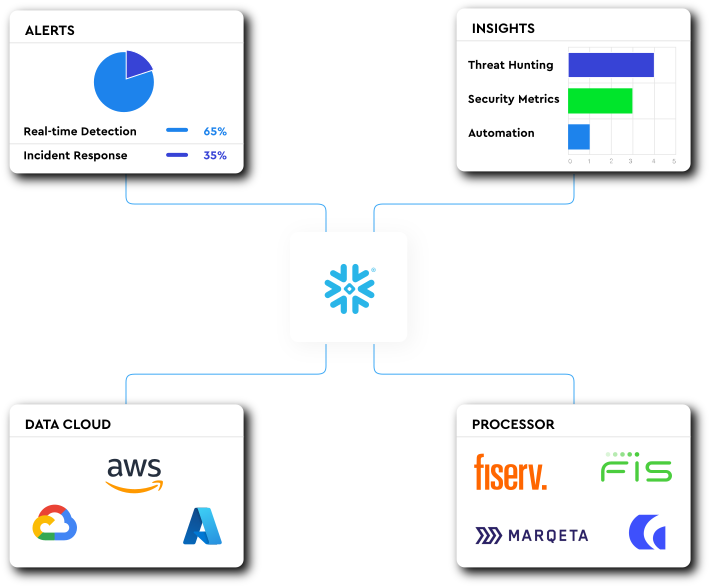
Centralized architecture resembles an air traffic control tower in which all flights, partners, and data streams appear within a coordinated radar system. Visibility enhances coordination, and coordination enhances stability. Stability, in turn, supports growth.
The most important community bank trend in 2026 may not be AI or stablecoins.
It may be this:
Unified data layers are supporting the growth of innovation.
Top Banking Trends for 2026 at a Glance
When you zoom out, what strikes me about all of this is how measured the industry feels right now. There’s energy around AI. There’s curiosity around stablecoins. There’s movement in regulatory posture. But underneath it all, the conversations I’m hearing are steady.
Bank leaders aren’t asking, “What can we launch next?”
They’re asking, “What are we actually ready for?”
That’s a healthy shift.
AI is exciting, but it forces you to look closely at your data. Stablecoins are interesting, but they force you to define a real use case. Growth through acquisition sounds attractive, but it forces you to understand how well your systems hold together.
Every one of these trends pulls on the same thread: clarity.
Clarity around where your data lives.
Clarity around how money moves.
Clarity around who owns what.
Clarity around what your customers actually need.
Community banks have always been good at playing the long game. They know their customers. They know their markets. They move deliberately. That posture feels especially valuable right now. The institutions that will feel strongest in 2026 are the ones who can sit in a board meeting, or across from an examiner, or in a conversation with a fintech partner, and speak plainly about how their systems work and why they made the choices they did.
That kind of confidence doesn’t come from chasing trends. It comes from understanding your business well enough to adopt change on your own terms.
And that’s what I’m seeing more of lately, banks taking the time to get clear before they get fast.
That’s a good place to be.